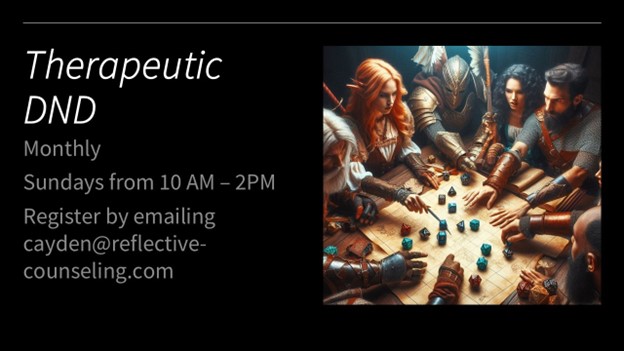
Therapeutic Role-Playing games are a great way to process emotions, build social skills and bonds, while having fun. Therapeutic RPG groups utilize mindfulness, social skills training, radical acceptance, behavior modification, imagination, and creativity to promote mental wellbeing and emotional health. You need no previous experience with role-playing games to participate.
Therapeutic Role-Playing Games (“Therapeutic DND” or “TTRPGS”)
TTRPGS are great for working on:
- Anxiety Management
- Character Development
- Emotional Processing
- Accessing cathartic experiences
- Skill Development
- Increase self-awareness and self-esteem
- Access to community, relationship building, and fun
- Access to novelty, curiosity, and exploration while maintaining safety
Group Size
Due to the need for focus on multiple therapeutic aspects of the game, the groups are limited to three to six players. Once there are three committed players, the date for the first session of the new group will be announced.
First Steps
Prior to the beginning of couples or group therapy, each individual will be asked to complete the “Interest Form” to assist the therapist and “Game Master” (GM) on what interventions and plot points should be introduced to the session.
You will then meet with a therapist. In this meeting, the therapist will:
- Assess if you are a good candidate for the group
- Gather background information to allow for more personalized interventions
- Assist you in identifying a priority skill or experience you would like to achieve
- Explore what special rules or circumstances that you would like to have present in your gaming experience that will help you reach your goals.
Length of Sessions and General Structure:
Sessions run for about four hours. The first thirty minutes to an hour is spent reviewing goals and boundaries of each player, as well as engaging in a “check-in” where participants will be asked to participate in a warm-up activity designed to encourage group cohesion and reduce anxiety.
The game will run for two and a half to three hours with a fifteen-minute lunch break in between. Participants are encouraged to bring lunch or provide a snack to share.
The last thirty minutes are spent processing the game, providing feedback and support, and identifying growth areas that you would like to focus on in the future.
Frequency:
How often the group meets will depend on you. Some people would like to engage on an ongoing campaign, where the story continues to develop and as you reach your goals, your character can also develop. Some people want isolated sessions without a connected plot, because they want to change their character or therapeutic goals, or do not feel comfortable with the constellation of players.
Attendance:
It is recommended that participants commit to at least two sessions to decide if this group structure is right for them. Whenever someone is starting something new, there tends to be an increase in social anxiety so one’s perception of other group members, and the behavior of other group members may not be indicative of how they would normally act.
DBT-Informed Couples Counseling for Parents:
Reflective Counseling has partnered with Vayda Therapy to begin providing couples counseling for parents using a group format. This provides a cost-effective option for couples therapy while also providing unique opportunities to connect with other couples encountering similar struggles. The group will focus on the following areas:
- Communication
- Trust Issues
- Life Transitions
- Understanding conflicts and attachment styles
- Parenting roles, identity, and experience
- Strengthening bonds
- Resolving conflicts
- Developing healthier relationship patterns
- Support and Validation
- Give and receive feedback
- Non-judgmental space
Group Size
Groups are limited to six couples. This allows for more quality interactions and interventions and reduces anxiety for those who are new to therapeutic groups. We recognize that not all romantic/sexual relationships consist of a couple, however, a group setting may not be appropriate for working out more complex relationship structures and would be more suited for a couple/family hybrid counseling approach.
First Steps
Prior to the beginning of couples group therapy, each individual member of the couple will be asked to complete a questionnaire about their relationship. This serves to inform the clinician of each individual’s perspective of the relationship while also providing individual histories that may be relevant to interactions within the relationship.
Each couple will meet with a therapist so that the therapist can assess if the couple is a good candidate for couples group counseling. This helps in determining how the quality of communication within the relationship and further help the therapist with where to focus group sessions.
Couples therapy is not recommended for relationships in which there is domestic violence, active infidelity, or if the couple is struggling with issues of active addiction. Couples Group Therapy is not a space to work out differences regarding the continuation of the relationship, navigating mediation, legal, or divorce procedures, nor custody issues. The clinicians take the side of supporting actions that will maintain a healthier pattern within the relationship, rather than ending it.
Length of Sessions and General Structure:
Each Session will last approximately two hours and meet twice per month. The first meeting of each month will focus on a skill and practicing that skill with the support of therapists and other group members. The second meeting of each month will primarily be utilized to follow up on how individuals and spouses felt that they did with utilizing the skills, asking questions, and providing feedback and support. The second group of the month will also be used to address issues brought to the group by couples and intergroup dynamics.
Because couples do not exist in a vacuum and relationship dynamics ebb and flow, so too will this group. Please expect flexibility in the group layout and respect the clinical decisions of the therapist regarding shifts in the group structure.
Frequency:
How often the group meets will depend on you. Some people would like to engage on an ongoing campaign, where the story continues to develop and as you reach your goals, your character can also develop. Some people want isolated sessions without a connected plot, because they want to change their character or therapeutic goals, or do not feel comfortable with the constellation of players.
Attendance:
Due to the organization of the group, it is not recommended that only one individual attend to collect and share the information with a spouse later. Due to the nature of parenting, and life in general, facilitators are aware that exceptions may need to be made from time to time, but this is to be a rare occurrence. If absences from an individual or a couple begin to disrupt the quality of the group, couples may be told that they need to cease services for now, until they can commit more fully to the process. Refunds will not be provided under such circumstances.
 Reflective Counseling